Sunday, May 25, 2014

Potty Training Girls - How to Potty Train a Child

I have managed a potty trained for the kids, and my three siblings, when they were aged between 22 and 28 months, in the course of a week. In the next few minutes, I will share my secret method, and hopefully, you can also say goodbye to doodie diaper, err, task, once and for all!

Around the age of 22-24 months, toddlers will show signs of readiness. Conscious pause in play for dirt, whining will change when wet or poopy are some signs of this. Also, have the verbal skills to communicate actions (simple "pee-pee and poo-poo will suffice) is important. Trying to determine how long the toddler stay dry on any given day. Means checking every hour to wet. When toddlers can" hold "for at least an hour, preferably two, he's ready for the next stage.

Potty Chair
It may sound strange, but kids learn from example! About a week or two before starting the final phase, make a scene when you go potty. Don't worry, the child will not know you look foolish. Standing outside the bathroom door, grab the front of your pants and put an apprehensive look on your face, and say something along the lines of "oh, no! pee-pee!" and dash into the bathroom. I guarantee the toddler will follow out of sheer curiosity and to see what the heck your problem is. If you aren't comfortable doing the deed in front of the child, pretend. Perform that act once or twice a day. Within a week or two, you are ready to proceed.
Hint: If there are older, potty-trained children around, the toddler will almost likely want to know what on earth is going on in the bathroom, and often will pick up clues by watching them instead.
Pick up a potty chair with the child. A simple potty chair is best. No fancy gadgets with bells, lights and sound effects. No toilet paper holder. No book rack. Just. A. Potty. Chair.

Good luck hope you succeed..!! 

Read the information and more on potty training tricks book:
Potty Train in Three Days & No Cry Potty Training Solution  

Saturday, May 24, 2014

how to potty train well and quickly

Development of children is a form of a mother's love, a mother should provide motivation motivation to learn, so that children develop properly and correctly according expecting mothers, 
following about toilet training in children under five years of age 2-4 years, especially at the age of 3 years the child will want a learning - learning that things can not be done, which is definitely not the mother noticed...??? 
We provide tips and products for the small toddler toilet training age, 
 
Toilet training tips 
  1. The mother obliged to wait for sure and if children make mistakes
  2. Give a game or joke jokes that children motivated to learn 
  3. Should not be too pressing child, if the child did not want to cry or want to learn, the mother should be patient enough 
  4. Patience, effort, intention, a mother that help the learning process
Small product piecemeal 
This product can help relieve the mother to insist on toilet training, 

The following products our products:

Read the information and more on potty training tricks book:
Potty Train in Three Days & No Cry Potty Training Solution


Friday, May 23, 2014

As a parent it can be frustrating to find yourself in the middle of potty training only to run in the same problem over and over!

By reading what is common and what is not you may soon realize how normal your potty training toddler may be.
  • A bowel movement is most likely to make its way out and your child asks for a diaper. Soon after you agreed to put that diaper on you noticed your child is hiding or standing in a special place to let go.  Surprise! Your child is physically; yet not emotionally ready to be potty trained. Instead of considering this a failure or abnormal, encourage your child to walk to the bathroom and dump the stool where it should go in the first place. Soon your child will understand that it's ok to let the poop go in its proper place. If you would like to take it one step further ask your child to have the bowel movement in the bathroom while wearing a diaper and soon, say good-bye to the diaper and sit your child on the potty.
  • Your child poops or pees right after he gets off the toilet.What an experience right? Well again... this is normal especially in the early stages of potty training due to the muscle control and relaxation which takes time to control them. If this happens often be prepared with extra towels and wipes, practice makes best, don't give up!
  • Regressing, the word most parents don't want to know about! Stress can send anyone to a comfort zone; just think of that box of chocolate you may have hidden in your show closet. Children going trough any levels of stress tend to reboot back to an earlier level of development or milestone crossed, and especially if the stress is recent. Give it time and it will pass. Since stressor can come from just about anything new I suggest you don't go back to diapers, but instead take a more relaxed approach and if possible identify what is going on in your child's life. Reduce the stress and help your child have more successes, it will all pass and before you know it you crossed one more stressor off your list.
Read the information and more on potty training tricks book:
Potty Train in Three Days & No Cry Potty Training Solution 
Thursday, May 22, 2014

Potty Training Girls - Potty Training Readiness

When should I start toilet training my child?

When Potty Training with us you and your child should be ready both physically and emotionally for toilet training.

In our experience we see that most children are ready when they are up to 5 months old, again at about 8 months old, 18 months old and between 22 and 30 months of age, although every child is different.

Toilet training can become a long and frustrating process if you try to start it before your child is ready to potty train and ready for potty training. Our professional trainers can help you with the process in getting and being ready to start potty training. Here at IPTS (International Potty Training Services) we believe a child is ready at just about any time, however psychologically a child may need a few props before they can accept the new routine and idea of being potty trained. Think about it your child had to learn how to eat, sleep, walk and talk. Potty Training is no different; it just takes a little time.
Most pediatricians agree that before children can use the toilet, they must be able to control their bowel and bladder muscles; however we disagree because every child needs a chance to potty train. Our children spend a lot of time in school, in front of television and in after school activities. Their muscles can and will develop by being used and exercised, and that is what we do at IPTS.
Pediatricians and the American household suggest that some signs of the bowel and bladder muscle control are having bowel movements around the same time each day, not having bowel movements at night, and having a dry diaper after a nap or for at least 2 hours at a time, that will keep your child in diapers until around 48 months old. They also agree that children must also be able to climb, talk, remove clothing, and have mastered other basic motor skills before they can use the toilet by themselves, true if your child can be kept in diapers until 5 years old, however most nursery schools and preschools want your child potty trained by 24 months old, and that is what we do.

Most children seem to be physically ready to toilet train before they are emotionally ready. We help your child through the process and help them decide to want to use the toilet and be willing to cooperate with you and us. Your child may even talk about being a "big boy" or "big girl" and wearing underpants rather than diapers. Training generally does not go well if your child is in the stage where "no" is his or her automatic response to every request, however we do sometime run through a dry phase and we help the child bypass it or we help the child work through it.
How long does it take to toilet train?
A child is considered toilet-trained when he or she knows that it is time to go to the bathroom and is able to climb onto and use the toilet with little help. In a study of children who started training between 22 and 30 months of age, boys were fully trained at an average age of 38 months, while girls were trained slightly earlier, around 36 months.

Your child will likely need help with wiping after a bowel movement until age 4 or 5. He or she may also need extra help in unfamiliar bathrooms, such as public restrooms, until about age 5 or 6.

What if my child resists?

If your child resists using the toilet, he or she probably isn't ready to start in that mindset. In about seventy hours we can help you and your family start on the right foot, and this is a requirement in order to use our service. Sometimes toilet training disruptions or delays are caused by stress or major changes in routine. Also, a child who is doing well with toilet training may suddenly have difficulty for no obvious reason. This is a normal part of toilet training. It is best to work with us during this time instead of just quitting, the child need consistency.

Your child's toilet training experience needs to be positive. If it becomes a struggle or a battle of wills, it is best to let us help you ease up for a while. Although you may be ready for toilet training, your child may not be and that is what we do, we help your child be ready.

Read the information and more on potty training tricks book:
Potty Train in Three Days & No Cry Potty Training Solution
When our daughter Katie was nearly 3, my husband and I primed her for potty-training success: We put the potty-related books in regular bedtime rotation, thrilled her with a fashionable array of brand-new big-girl panties, and stocked up on a tantalizing incentive -- M&M's.
Within two months, Katie was peeing in the potty like a pro. But no matter how much we bribed, begged, and flattered her, she refused to give up her Pull-Ups to poop. I tried every tactic I could think of: I upped the ante to a Price Is Right -- worthy prize package, took away the Pull-Ups (resulting in a serious bout of constipation and some nasty post-nap cleanups), and even, I'm ashamed to admit, threatened her with a doctor's visit and shots if she didn't do the deed. After poring over every mom board I could find, I discovered a few new ideas -- but, mainly, lots of other desperate moms.
Since no strategy can possibly fit all our quirky kids, it seems that success depends on finding the solution to your child's particular sticking point. These are the five most common, and the best tricks for getting unstuck:

1. Your kid isn't swayed by chocolate kisses, a cool truck, or any other reward
2. You found dirty undies under the bed
3. Only the potty at home will do
4. She was doing great -- and now she's not
5. He reserves number two for the diaper

Your kid isn't swayed by chocolate kisses, a cool truck, or any other reward

What's going on: The terrible twos (or threes) have kicked in, and your child's chosen to just say no -- even if it costs him an Oreo and a Lego. Your kid's aware now that you and he are separate people -- and that means he doesn't have to do what you say. The power! For an iron-willed kid, that tastes a lot better than any old piece of candy. Resist searching for a better prize: That'll only give him more veto power.
Try a little reverse psychology. After months of attempting other tricks, Nina Vultaggio of Coto de Caza, CA, simply begged her son not to use the potty. But sneakily. "I said that pirates from Disneyland called and wanted him to be a pirate, but he couldn't because they only wanted potty-trained boys," she says. "I told him not to do it because I didn't want him to be a pirate -- and he trained that day." Vultaggio splurged on a trip to the local amusement park (which happened to be Disneyland), where a staffer proclaimed her son a pirate. Your plan can be simpler: You can tell your kid you hope this isn't the week he makes the switch, because then he can sleep over at Grandma's and you'll miss him. Reverse psychology works, of course, because of the thrill of doing the opposite of what you say -- but it also takes the pressure off.
Offer a different kind of incentive. Many parents (myself included) head right into the stickers and M&M's, and they're fine, if they work. But if they don't, think about what'll make your kid proud. Does she adore a particular uncle? Play up how fun it'll be to call him with the good news that she's potty trained. Does he perk up at the mention of being a big kid? Offer a "big-kid bedtime" as a reward, and let him start staying up 15 minutes later than usual.
Reward yourself. This one may sound like a truly desperate move, but it worked at my house when Katie was unimpressed with M&M's. You give yourself (and your husband -- remind him you're a team!) a reward for doing the deed, says Teri Crane, author of Potty Train Your Child in Just One Day. "Get two jars: Fill one with change and decorate the other with a picture of an amazing trip or another special prize," she says. Then when one of you goes, move a coin to the prize jar. Act as excited as possible. This may mean clapping for yourself or (worse?) for your husband. Crane says it often takes just a few days before your kid wants in on the fun.

You found dirty undies under the bed

What's going on: Three-year-olds may get a charge out of being difficult, but at heart they want to please you. They're old enough -- and this potty-training thing tends to be all-consuming enough -- to know perfectly well what it is you want from them. So if your child uses the potty with great success and then has an accident later, she may be too upset to tell you. Hence, the hiding of the smelly panties.
Let your kid know you're on to her. Don't just clean up the mess, thinking that'll save your child from shame. "Then she believes her secret is intact," says Peter Stavinoha, Ph.D., coauthor of Stress-Free Potty Training. Tell her you found her underpants, and add: "It's okay to have an accident! Just let me or Dad know if you do." She'll see she doesn't have to worry about how you'll react.
Take a breather. The tension may just be too much. Yes, it's tough (for you) to take a time-out, but putting your child back in diapers -- even for as long as two months -- will help her relax and make training easier when you go back to it.
Try not to care so much. Ha, right? Well, think of it this way: Potty training is a process. The end goal is great, but getting there takes time. Remember, this isn't about you. It's even harder for your child, so try to get rid of any nagging feelings that you're failing here. No one is. She'll get there.

Only the potty at home will do

What's going on: Kids take comfort in the familiar -- so the weird noises and smells and strangers in the other stalls can very well make your new potty user nervous. Holding it till he gets home is, to him, a small price to pay for security.
Make every potty feel more like home. Get a travel potty seat and have your child customize it with stickers. Practice using it at home first, Crane suggests, and then when you're out, make the bathroom the first stop, if you can. Your child can test out his special seat on the new toilet and make sure it "works" before he needs to go.
Turn bathroom trips into adventures. A kid who's skeptical of a new bathroom might be compelled to test out how the sink works, count the number of stalls, or listen to the flusher. That way, it's not just about the pressure to go on the potty, and he might feel comfortable giving it a try.
Pack some Post-its. Those loud, scary self-flushing toilets are often to blame for potty phobia. A quick fix: Stick a Post-it over the toilet's electric eye until your child's finished and heading out of the stall.

She was doing great, and now she's not

What's going on: Most likely, there's been a shake-up in her routine. That could be something big, like a new sibling or a new house, but even a weekend away or a friend's birthday party can trip up a stellar toilet-training toddler. "If things suddenly aren't as predictable for a child, she loses her sense of security -- and will revert back to something that's more comfortable," Stavinoha says. Don't consider this a failure on your part, or your child's. Setbacks are normal.
Don't reinvent the wheel. "If she was going perfectly on her potty chair but a setback occurred soon after the switch to the big toilet, go back to using the little potty. If she responded to two-hour potty reminders, begin setting a timer to remind her to visit the bathroom," says Elizabeth Pantley, author of The No-Cry Potty Training Solution. A new tactic isn't necessary -- and won't give her the familiarity she needs.
Put your kid in charge. When your kid's stressed, it's normal to want to take over and do the worrying for her. But it can help to give her control. Tell her to let you know when she's ready to start again -- it might be sooner than you think.

He reserves No. 2 for the diaper

What's going on: There could be any number of reasons your kid will give up the diaper to pee but will simply refuse to poop in the potty. He may not want to take a break from the action to sit still on the potty, for one, or he may be fearful after toilet water unexpectedly splashed up during his last poop. The diaper might make him feel secure, so giving it up entirely is a bigger step than it seems. Often, constipation's to blame. It hurt last time, so why would he do it again?
Take it slow. Break the transition from Pull-Up to potty into baby steps. "If your child will only go in a diaper, have him do so in the bathroom, then progress to having him sit on the potty in his diaper," Pantley says. "Once he's used to this, suggest taking his diaper off and putting it into the potty-chair bowl as a 'pocket' to catch his poop."
Pump up the fiber. If constipation is the culprit, load your child up with high-fiber foods like beans, most fruits and vegetables, and whole-grain pastas and breads (skip the cheese and bananas, which can make constipation worse). If that doesn't solve the problem, have a talk with your child's doctor.
Try a little bit of everything. When Katie was balking at pooping, we decided to take a breather for a month. Then we put her on a doctor-recommended high-fiber diet, and gave her a sticker every time she sat on the potty. She soon discovered that pooping on the potty wasn't really so bad. It took a mishmash of techniques -- and a giant Costco box of lollipops -- but Katie's now out of diapers, and I've learned a few tricks to use on her sister next year.

Read the information and more on potty training tricks book:
Potty Train in Three Days & No Cry Potty Training Solution

Tuesday, May 20, 2014

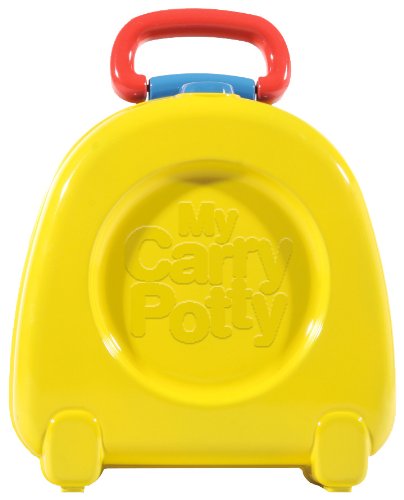
Potty Training Girls - My Carry Potty (Yellow)

My Carry Potty My Carry Potty - Yellow
The Only Potty Chair your toddler will ever need. My Carry Potty was invented by a mom to help with the challenge of potty training at home and on the go. Great carry handle - kids will love. Compact and fun - children make My Carry Potty their own - making potty training easier. Completely leak proof and odor proof seal for potty training on the go too. Small enough for the car. No messy bags needed. Comes fully assembled and ready to go. 

Technical Details
Item Weight  1.5 pounds
Product Dimensions  9.2 x 5.1 x 9.9 inches
Item model number  0017
Target gender  Unisex
Minimum weight recommendation  16 Ounces
Maximum weight recommendation  96 Pounds
  • Perfect at home and on the go
  • Lightweight and easy to carry
  • Leak and odor proof
  • No costly disposable bags
  • Great emergency potty in the car
  • See more product details
Customer Reviews By S. D'Anna
My Carry Potty (Yellow)
Our daughter potty-learned in 6 days at 25months using this potty and the Pottette Plus. Best of all, we didn't need to sit around the house perching her on the toilet: the My Carry Potty let us go out and about as we normally do, snapping open the potty as soon as she needed to go, then disposing of the contents later if necessary.

The reviews regarding the difficulty of opening the potty seem to have not gotten the trick of it. It did take a couple tries to master, but it's very easy to open (without spilling, even) if you unlock it and grip the rims instead of trying to pull the latch mechanism. When dealing with toddler poo, you'll appreciate the tight seal that keeps in smells even in a hot car in summertime. If you are carrying it empty, you could leave the latch partially engaged instead of totally sealed - saves 2 seconds opening the potty.

The handle is the perfect size - comfortable for small toddler hands and still big enough for adults to carry easily. The potty overall is light enough for a toddler to carry, and my daughter likes the fun of being responsible for her special seat.

At home, we also have the Pottette Plus on the big toilet and a couple Baby Bjorn Little Potties in other rooms.

Customer Reviews By Lisa C
My Carry Potty (Yellow)
One would initially think this is a good idea. My only reason for giving this two stars is that it is cute and gimmicky in a joke gift kind of way. While the concept is helpful being that you could really be pretty much anywhere and have a child use this, there is a major issue with this. You are supposed to be able to close this after use and have the waste shut and sealed inside. To their credit the makers have achieved this. The seal is great and nothing will leak. However, once shut the seal creates an odd vacuum that holds it together so hard you have to really force it to open it. So when it does finally pop open the contents will be all over you and anything in a 10 foot radius. I had a sneaking suspicion this would be the case after it took several frustrating attempts to open it the first time. So I tested my theory with water and that was the case. When it did finally open the contents splashed everywhere. Also note...as clearly stated in the instructions...because of the vacuum seal...you absolutely should not attempt to use this on an airplane.

Read the information and more on potty training tricks book:
Potty Train in Three Days & No Cry Potty Training Solution
Communication is probably one of the biggest difficulties in teaching a special needs child how to potty train.
My Carry Potty My Carry Potty - Yellow
If your child is ready for the most part , but they can't verbally tell you when they need to use the potty, then how will you ever know?
Working hard at anticipating their needs without communication would be difficult and as you know can lead to accidents.
Here are a couple of sugestions from our clients to help you: 
  • Use sign language
    One of our clients experience: "We taught our twins some simple signs when they were little. One sign my oldest picked up right away was diaper, and the younger one pee. When it was time to start potty training our twins were not using much functional language, however with a few sign language words we got by. My oldest couldn't walk to the potty himself. He did sign for us when his diaper was wet or later on when his underwear were wet and we could work with that little bit of language to help him tell us when he needed to go. Learn more about teaching visually impaired babies sign language.
    BABYBJORN Potty Chair - Green
  • Use tangible symbols.
    If coordination may be an issue for your child are not able to use sign language, you may want to try using tangible symbols. Keep these symbols handy, and teach your child how to use them to communicate their need to use the potty by simply touching the symbol. A good symbol to use for the bathroom is a piece of remnant tile or an empty roll of toilet paper. Most bathrooms have tile in them somewhere and the tile will feel reminiscent of the toilet itself while the empty toilet paper roll can resemble the need to be clean.
The reward of having a child trained is so worth the journey of potty training. May you have a great experience and remember accidents are part of learning and journey itself.

Read the information and more on potty training tricks book:
Potty Train in Three Days & No Cry Potty Training Solution
Potty training a child is difficult under any circumstances, however before you can begin potty training, 

we suggest you take their abilities and delays into consideration if your child has special needs.
This may seem like a daunting task and if you worry about your child, believe he or she will take a long time to toilet you will be train if you take your time and prepare your child you can achieve potty training success!
The first step in potty training is to familiarize yourself with the basics behind the task. 
When you've got those basic concepts down (and I'm sure you're already aware of which tactics will work for your special child and which won't), you'll be ready to decide if your child is ready to begin potty training.

When Is My Child Ready to Begin Potty Training?

There are a few signs that will let you know that your child is physically ready for potty training, however with the right preparation and training your child can start training at any time. For example, you may notice that your child's diaper stays dry for about two hours at a time during the day, their bowel movements come at regular times, and (usually) they stay dry through the night.
For normally developing children this will usually happen between the ages of two and slightly after their third birthday.
But it's important to remember that children with special needs move at their own pace and forcing potty training on a child who just isn't developmentally ready will not only be a waste of time, it will also be a horrible experience for both you and your child.
How will you know when your child is developmentally ready for potty training? Here are some signs to look for...
  • Your child can follow two-step instructions
  • Your child can communicate a need to go
  • Your child can imitate others
  • Your child is willing to cooperate
  • Your child shows a need to be independent
  • Your child can get to and from the toilet independently
  • Your child is aware of wet or soiled diapers
  • Your child is able to pull pants down and maybe even up
  • Your child is able to sit on the potty for 5 minutes without help
Of course, not all kids will be able to do all of these things, but you should have a good feel that your child is on the right track developmentally to handle potty training. If you feel your child is both physically and developmentally ready to begin potty training, then it's time to get started!

Read the information and more on potty training tricks book:
Potty Train in Three Days & No Cry Potty Training Solution

Monday, May 19, 2014

I believe toilet training is mostly a decision parents need to make as soon as they as parents are ready.

A child will learn to do just about anything if the parent is wiling to teach. Think of the first time your child latched on to your breast or a bottle to eat. Think of the first time your child started walking.

A Toddler
Potty Training 
There are developmental stages in life however just like the need to eat and digest the food a child eats, the need to eliminate is there from the day a child is born. The saying "your child must be both physically and emotionally ready for toilet training" I believe is not true.

Toilet training my youngest daughter as an infant proved to me over and over the choice I have every day to either put her in diapers and allow her to soil her self while desensitizing or I could hold her and teach her that's ok to feel and eliminate.


Of course I chose to let her feel and teach her to eliminate. I am a proud mom and would like to share that my little Abbie was fully potty trained by four months old and once she learned to sit and crawl she would use the potty on her own.

With the use of diapers I need to agree with most experts who say most children are ready when they are between 22 and 30 months of age, although every child is different.

Potty training can becomes a long and frustrating process if you try to start it before your child is ready emotionally and physically once you have used diapers, however with the right amount of time and tools it can be done at any stage in your child's development.

Potty Training at 11 mo
Before a child can use the toilet, he/she must be able to control their bowel and bladder muscles.

Some signs of this control are having a dry diaper after a nap or for at least 2 hours at a time, having bowel movements around the same time each day and not having bowel movements at night.

For total independence a child should also be able to climb, talk, remove clothing, and have mastered other basic motor skills before they can use the toilet by themselves, and until then a parent should be willing to offer support.

I believe most children are physically ready to toilet train before they are emotionally ready.

Your child must want to use the toilet and be willing to cooperate with you. He or she may even talk about being a "big boy" or "big girl" and wearing underpants rather than diapers.

Training generally does not go well if your child is in the stage where "no" is his or her automatic response to every request, however giving it enough time will create not only a bond it will also create trust and follow the leader game will have a brand new meaning.

When did you start potty training and how did it go?

Read the information and more on potty training tricks book:
Potty Train in Three Days & No Cry Potty Training Solution
Potty Training Girls - Potty Training Process


What is the right time frame for potty training? 

In a nutshell: we believe when you are ready! I know some parenting experts may disagree with me, however I believe potty training can be done like anything else, that’s why is called training. Unlike other developmental milestones, kids are programmed with one-of-a-kind schedules — some say it's crucial to let your child set the pace for when to start potty training, and I attend to some degree, however I also believe it is crucial to train your child as early as possible for several reasons:

·      School
·      Camps
·      Play dates
·      Development
·      Savings
 
If your child is past eighteen months you can probably look for some of the following potty-training
readiness signs:

1.    Changing fewer wet diapers
Until about eighteen months, kids pee so frequently that expecting them to control their bladders is probably unrealistic. But a toddler who stays dry for an hour or two at a stretch — and occasionally awakes without wetness — is physically ready for potty training, however knowing that practice makes perfect I suggest use the frequent potty breaks to teach your child instead of changing diapers.

2.    Your child's bowel movements are predictable

Whether your child has a BM in the morning, after meals, or right before bed, “a regular rhythm will help you anticipate when to pull out the potty — and thus boost his likelihood of success” some experts say, however what I say is use diet, rest and patience to get your child to have regular BM as well as get the timing just right, after all do you have a BM at the same time every day?

3.    Your child broadcasts bodily functions

Some children happily announce when a bowel movement is about to or through less-verbal means — say, by retreating to a corner or producing a preemptive grunt. No matter what the signal, if your child shows he's aware of his body's functions, he's ready for potty training, and I have some good news… your child did that the first time he/she had to pass a BM or urine.

4.    Your child despises dirty diapers

Every time your child has a meal, the child needs to use the bathroom and every time your child (as a baby mostly) cries because he/she is wet they communicate with you and you have an opportunity to train, however over time the child becomes desensitized and the diapers more absorbent. By the time your child reaches toddler stage or preschool stage he/she learn how to open the diaper and maybe even tell you they are dirty. As you can see the child communicates at every stage, however the parent needs to learn how to take initiative and start the training.

5.    He or She is able to perform simple undressing
If you would like for your child to be independent at potty training when nature calls, the potty won't be of much use unless your child can quickly yank down his trousers or underwear, and girls should be able to pull up their skirts in a flash, however if your child is younger and motor skills are still in development be of help, you will be glad you did.

6.    Your child understands bathroom lingo
Whether you prefer kid-friendly jargon like "poop" and "pee" or formal terminology like "defecate" and "urinate," your child's ready for potty training if he understands and is able to use the family's words for bathroom functions and any associated body parts.

7.    Your child demands a live demonstration
If your child has toileting on the brain, he'll want to see how the experts do it. So don't be surprised if your little one follows you into the bathroom to have a look.

Read the information and more on potty training tricks book:
Potty Train in Three Days & No Cry Potty Training Solution
Saturday, May 17, 2014

Did you know your toddler is listening to absolutely everything you say and he is storing it away at an incredible rate?

In our previous article we looked at Effective Communication with Toddlers, and this week we are looking at Language Development in Toddlers. I hope you find this short article helpful in your journey as a parent.

I would like to encourage you to use the correct names for people, places, and things when you address your toddler instead of using a “baby talk” form of conversation. It is also best if you speak slowly and clearly, and keeping it simple for your toddler to follow and actually engage in conversation.

Your toddler may continue communicating with gestures by pointing at pictures in a book, handing you his shoes or jacket when he wants to go outside, pointing at something he wants, imitating actions and may very well use them in play.

Encourage him to use gestures because they are an important part of language and comprehension development. 

As a parent or educator you can make the connection between gestures and language by using a running commentary such as, "Do you want a banana?" (when your child points to it) or “Do you want a drink?” (when he points at the sink or a beverage), then wait for a response.
Once he is done communicating ask him, "What do you want, juice or water? Allow him to respond by making a choice and say to him, “OK, let's get some water." If you encourage this type of behavior it encourages your toddler to respond and participate in conversations, therefore his vocabulary will increase and so will his communication skills.

Your child will probably enjoy gesture games as well such as pat-a-cake and so-big, and identifying things, like body parts, pictures or objects, and familiar people. You can use questions like "Where's your ear?" "Show me the ball" and "Where is Mommy?"

Pronunciation may not be as clear as his communication since his vocabulary is growing at such a pace and most two year olds can be understood half the time. Repeating to him what he said with the correct pronunciation helps. Remember he is a toddler and “baby talk” is no longer cute.

Should parents be concerned if their child does not talk by a certain stage in his development or age?

How old was your child before you could understand him or her?

Do you have any concerns about your child?

Read the information and more on potty training tricks book:
Potty Train in Three Days & No Cry Potty Training Solution
The issue of when and how to begin toilet training can be particularly challenging for parents of children with special needs. While no parent wants to push an already challenged child to perform in ways that are impossible, the sense of accomplishment experienced when he does succeed in this important aspect of self-care can make an enormous difference in his level of self-esteem.
Perhaps more than other parents, those who have children with physical, intellectual, or developmental disabilities can appreciate the toilet-training process as a way to follow and celebrate a child’s overall growth. Rather than focusing on their child’s mistakes, which are inevitable in any case, they can use this opportunity to discover how he learns best and to demonstrate to him that he is able to progress.
Toilet training works best when parents of children with special needs have access to the guidance, instruction, and encouragement of their pediatrician, other trained professionals, or support groups. The first step you must take is to determine whether your child is ready to begin.
Signs of readiness are the same for your child as for all children: 
  • Is your child aware of the difference between being wet and being dry? 
  • Can he stay dry for at least two hours at a time? 
  • Can he sense when he needs to urinate or have a bowel movement?
  • Is he capable of reaching the toilet or potty in time (perhaps with your help)?
  • Can he undress and dress himself or is he ready to learn?
  • Is he motivated at some level to take this next step? 
If your child is in a resistant phase, is not ready to take on a new challenge, or does not yet feel the urge to behave “like other kids” in this way, you might take some extra time to prepare him mentally before starting the training process.
If you feel that your child is ready, ask your pediatrician for her opinion. She can examine your child to offer a physical assessment and perhaps offer special insight into the particular needs of your child. She can also provide further information that you may need before starting, and let you know what types of special equipment may be advisable.
It is also important to prepare yourself emotionally before you and your child embark on this experiment. Children with special needs often begin toilet training later than other children, frequently completing the process at age five or even later. (Of course, children with severe physical disabilities may always need help with clothing and accessing the bathroom). Learning to use the toilet can be physically painful to some, initially incomprehensible to others. Accidents will happen, of course, and you will need to draw on an extra dose of patience and humor when they occur. Lining up help from your spouse, relatives, or friends before you begin training—to spell you periodically as well as to help boost your morale—is a wise move for your child’s sake as well as your own.

Physical Challenges

A number of physical disabilities and illnesses can hinder a child’s ability to become fully toilet-trained or easily adjust to bathroom use. If your child faces such a situation, you will need to think about how her disability affects each stage of toilet training and how you can compensate for this disadvantage. Whether your child is unable to sense the need to urinate, has difficulty getting onto or staying on a standard potty or toilet, or must adjust or readjust to toilet use after having used an ostomy device, she will need extra support from you and her other caregivers as she learns to master this new skill.

Visual Disabilities

Children with visual disabilities and those with sight deficiencies experience a disadvantage at several stages of toilet training. First, they are unable to observe family members and peers using the toilet, so they cannot mimic their behavior. So many details of toilet or potty use—where the potty is in the bathroom, how the body is oriented to it as one sits down, how the urine and feces get into the potty, how one tears off and uses toilet paper—are simple to understand if a child can observe the process but difficult if she cannot. Without sight to help her, your child will need to rely more on language to understand how the process works. Therefore, you will probably want to wait a little longer to begin—until she is three or four years old (or even later, since language delays can accompany blindness)—so that she can fully comprehend what you are telling her.
When you are ready to introduce your visually impaired child to the concept of toilet use, start bringing her with you when you use the bathroom. Allow her to explore the bathroom and locate the toilet. (Be sure it’s well ventilated and smells pleasant so she will want to return.) Place her hands on your shoulders so she can feel you sitting on the toilet, explain what you are doing and why, and guide her hands to the toilet paper dispenser. Also show her the flush handle and the sink for hand washing. Once you have placed a potty in the bathroom, lead her to it, let her accustom herself to its presence, and keep it in the same place throughout the toilet-training process. Talk to her about toilet use at other times, too—pointing out that most of the people she knows use the toilet and that toilet use is a sign of being a big kid who can take care of herself.
Once she begins practicing potty use herself, you will need to keep the bathroom and the passage to it clear of obstacles. A musical potty that is activated when urine hits the bowl might make the learning process more fun. Teach her to feel the inner edge of the seat before tossing in the toilet paper and, if the child is a boy urinating standing up at a toilet, to position his body so he doesn’t urinate on the toilet. Finally, as she grows more comfortable with bathroom use, make a point of taking her to the bathroom at each public place you visit. By helping her familiarize herself with the wide variety of bathroom layouts and toilet styles, you will help build her self-confidence when away from home and prevent accidents. And don’t forget to reward her progress with praise, hugs, or a small, favorite treat.

Hearing Disabilities

Children who are deaf or have difficulty hearing may or may not find toilet training challenging, depending on their ability to communicate. A child who is already fluent insign language can rely on a combination of visual observation and explanations from you to understand what’s expected of her—much like any other child. Children who do not yet have the ability to understand your signals and simple signs may not be ready for toilet training until they are somewhat older.
The key to training in these cases is to keep the process simple. When introducing the concept, emphasize the visual: Allow your child to observe you (and, even better, other children) using the bathroom, and show her picture books about it. Choose one gesture or sign for the essential terms (pee, poop, potty, wet, dry, and need to go). Use these gestures each time you use the bathroom, and use them with her as well—signing “wet” (with a sad face) when you change her diaper or wet underwear, “dry” (with a happy expression) once she’s been changed, and “need to go” after lunch when it’s time to sit on the potty. As long as you are consistent and stick with the half-dozen signals you need, your child will get the hang of potty use without longer explanations. When she does, be sure to reward her with plenty of hugs, stars on a potty chart, or even candy or another small treat.

Continence Problems

Some conditions have no effect on a child’s ability to understand the process of toilet training but make it difficult for a child to comply. Your child may grow increasingly frustrated in her efforts to stay dry and may even give up trying. The best solution to this dilemma is to put your child on a regular potty schedule. By placing her on the potty frequently (reminding her every hour or so to visit the bathroom), you remove the burden of having to acknowledge so many times each day that she must interrupt an activity to tend to her physical needs. Going to the bathroom at the top of every hour can become a habit similar to brushing her teeth twice a day or receiving her insulin—freeing her up to focus on other activities between visits. 

Cerebral Palsy

Children with cerebral palsy not only tend to be slow in developing bladder control, but may not have enough bladder awareness to begin toilet training at age two or three. If your child has cerebral palsy, she will need to be helped to develop an awareness that she needs to go (which may be signaled to you when you see her clutching her genitals or fidgeting anxiously) before she can begin toilet training. She will have to be able to delay urination until she is in position on the potty. She will need to remove her clothing and then hold herself on the potty (with supports) long enough to achieve success. Again, these challenges mean that it is usually best to wait to toilet-train until she is older.
Chances are that limited physical activity, undeveloped muscle tone, or medications tend to cause constipation for your child with cerebral palsy, so pay special attention to her diet as you initiate the toilet-training  process. Be sure that she is drinking plenty of fluids and ingesting lots of fiber. As she begins to practice removing her clothes before getting onto the potty, make it easier by providing clothes with Velcro fasteners or loose elastic waistbands. (She may find it easier to remove her clothes while lying down.) Since she will have trouble supporting her back, you will need to provide a special potty with back and side supports. (Potties designed to fit in a corner work especially well, since the right-angle back support holds the child in position with shoulders forward, hips bent, and knees parted.) If your child has severe disabilities, you might begin by sitting in a chair with the pot from a potty wedged between your knees. Place your child on the potty with her back against you and hold her in position until she urinates or has a bowel movement. Later, you may be able to graduate to a potty with adequate supports.

Spina Bifida and Spinal Cord Injury

Spina bifida, spinal cord injury, or spinal tumors create toilet-training problems for young children similar to those of cerebral palsy, but since most children with this condition never develop an awareness of when they need to go, few can ever fully use a toilet. You can, however, teach your child to remove urine through a catheter on a regular basis, and to visit the bathroom for bowel movements on a regular schedule. (A high-fiber diet with plenty of liquids and meals served on a regular schedule will make this process easier. Sometimes a stool softener or even a suppository or enema is required.) Since your child will find it difficult to remove her clothing, be sure to provide her with Velcro fastened clothes and allow her to lie down to undress if necessary.
Parents of children with physical disabilities such as cerebral palsy or spina bifida may become so distracted by the need for special equipment or physical support that they neglect the necessary cognitive and emotional input that all children need to succeed at toilet training. Don’t forget, while installing that special potty in the bathroom, to talk to your child about bathroom use and why it’s important, to let her observe you and others using the bathroom, and to praise and reward her when she succeeds even a little bit. Resist the temptation to let things go when she resists or protests a little, and remain firm about the schedule or routine you have created—unless the experience becomes negative and your child becomes very resistant. Remember, her progress in this arena is especially significant if it increases her self-confidence and prepares her for more challenges. Give her all the information, attention, and support she needs to succeed.

Behavioral Disorders

Your experience toilet-training a toddler who is behaviorally, intellectually, or developmentally challenged will depend a great deal on your particular child’s temperament, behavior patterns, and coexisting conditions. In this arena more than any other, perhaps, the parents’ knowledge of a child’s strengths, weaknesses, tendencies, and interests will help her through the process as much as any general guide.
Toilet training can be particularly trying for parents of children who have intellectual or developmental disorders or who are behaviorally challenged—including those withautism, fetal alcohol syndrome (FAS), oppositional defiant disorder (ODD), and, in cases when it is diagnosed this early, attention deficit /hyperactivity disorder (ADHD). Many children with these conditions may not be strongly motivated, or sufficiently equipped, to respond to the social reinforcements that work so well with other children (“What a big boy!”), though small tangible rewards such as candy or a toy can be effective. Most find it extremely difficult to adjust to any change in routine. Some are particularly sensitive to touch and other sensory input and become upset by the frequent pulling off and on of clothing, the physical closeness with an adult, and the unfamiliar surroundings of the bathroom. Simply getting across the concept of potty use can be complicated by the fact that some children with behavioral disorders do not naturally imitate their parents’ or peers’ behavior, while others learn only through simple imitation or other concrete, nonverbal demonstrations. Such complications in the training process mean that early efforts can create a high level of frustration in your child and may lead to displays of temper, stubbornness, and refusal to cooperate.
Still, nearly all children with these conditions can be toilet-trained—though in some cases the process may take up to a year or even longer. Your first step, again, is to determine whether your child is ready to start training. There is no point in beginning until you see that he can stay dry for an hour or more at a time, has regular bowel movements, is aware that he is about to urinate or defecate, and dislikes being wet or soiled. It is also important to have your child examined by his pediatrician, since he may be at a higher risk for constipation or loose stools, which may interfere with training.
Once you have decided to begin, observe your child and consider carefully the specific traits, patterns of behavior, and obstacles that may impact his learning process. If he seems to dislike entering the bathroom, determine what the cause of his discomfort is—the smell of disinfectant? the cold floor? the flushing toilet?—and change or neutralize it if possible (change cleansers, put socks on his feet, move his potty away from the noisy toilet). If he does not overtly signal the need to urinate or defecate, does he pause just before voiding or otherwise behave in a way that will provide you with a cue? At what times, or how long after eating or drinking, does he usually urinate or defecate? What foods, toys, or other objects is he most passionate about? (These can be used as tangible potty-training rewards, which may prove more effective than praise.) How does he learn best—with firm but gentle physical demonstrations (being placed on the potty at regular times), a formal routine containing a series of simple and predictable steps (verbally explained and reexplained, illustrated with pictures, or listed on a chart), or offhand comments and conversations that inform without inviting resistance?
Once you have made the necessary adjustments in your child’s environment and your teaching style, it is time to start working toward his first success. Some parents like to begin the training process with actual potty use—putting their child on the potty at a likely time and rewarding him when he uses it. Others—particularly those with a child who resists entering the bathroom—may want to focus on preliminary steps first. They may start by rewarding the child for entering the bathroom, then for approaching the potty or toilet, then for sitting on it, and finally for using it. To make this process easier, and to avoid the physical closeness that your child may resist, consider letting him wear only his underwear at first, or even nothing below the waist. Handling clothing can be taught at the very end of the process, once the bathroom routine has been accepted as part of his day.
Your child is likely to be resistant to adopting this new habit. It’s important to insist, however—firmly but matter-of-factly—that he try. When accidents occur, point out that you disapprove, but don’t punish or criticize your child for making a mistake. If he is verbally challenged, be sure to stick to simple instructions such as “Wet! No!” As he gradually gets better at using the potty—motivated for the most part, perhaps, by the prospect of a tangible treat—your child’s love of routine will begin to work in your favor. He will expect to visit the bathroom at predictable times and may even become upset if this doesn’t happen. Until then, you will need to remind yourself how difficult this major step forward is for him. You should also think about how to find support for yourself as you search for the patience you will need to succeed. Both you and your child are embarking on a difficult developmental task.

Intellectual Disabilities and Developmental Disorders

Most children with a developmental delay, an intellectual disability, or a pervasive developmental disorder (for example, autism) can be toilet-trained, though the time it takes to achieve success ranges from a few months to a year or more. The process becomes easier as your child achieves at least a minimal level of verbal ability, is able to manage his clothes (perhaps with some help from you), and shows awareness of the need to go. As you introduce your child to the concept of potty use, be sure to keep your explanations very simple. Start by checking the state of his diaper or pants every hour or so and offering a one-word, nonjudgmental comment when he is wet (“Wet!”). Shake your head and then, after you change him, smile and say “Dry!” If his verbal skills are very limited, you might substitute a special gesture or sign for the words wet, dry, potty, need to go, and so on. Begin bringing him to the bathroom with you when you need to use it. Smile and say “Dry!” after you’ve finished and pulled your pants up. If at all possible, have your child observe other children using the bathroom, too. He may make the connection between himself and another child more easily than between himself and you. After you’ve finished and are dressed, show him how happy you are and tell him “Dry!” If he has a favorite doll or stuffed animal, use it to play “potty,” demonstrating again how the potty is used.
When he is ready to begin using the potty, begin setting him on it at regular times—quite frequently at first (as frequently as you checked him for wetness earlier) and then gradually settling down to the times when he usually voids. Try to keep him on the potty for five or ten minutes at a time—keeping him company, reading to him, playing tapes of children’s music, and otherwise ensuring that he stays in place long enough to succeed. Once he does urinate into the potty, give him a big smile and say “Pee!” (or whatever word you have chosen for this event). Help him wipe off and then praise him with a happy “Dry!” and give him a treat. Food treats are often very effective and can be phased out once he has been trained. Eventually, with enough repetition, he will understand the connection.
Children with an intellectual disability or developmental delay are best toilet-trained one step at a time. Don’t expect your child to learn to signal or announce his need to go, pull down his pants, use the potty, wipe his bottom, and wash his hands all at once, the way his peers might. Toilet training will work best if you focus on the actual act of elimination first and address the other skills later. It is more important to keep him motivated than to achieve instant success.

Read the information and more on potty training tricks book:
Potty Train in Three Days & No Cry Potty Training Solution
Successful Potty Training Book